
Part 2 of 2. Part of the ongoing Big Tech's War on Users series.
Part 1 covered the privacy brand — the Google deal, iCloud, Meta, and what "we keep your data safe" actually means. This post is about the other half of Apple's brand: the idea that their judgment is worth the premium. That they know best. That the walled garden exists because Apple's choices are better than yours would be.
Let's look at the choices.
Quick credentials for anyone landing here first: iPhone since the 4S, Mac for iOS development, Apple Music, iCloud subscriber. I like Apple products. I'd still broadly trust them more than Google or Microsoft. That's not what this is about.
The thing that makes Apple different from other tech companies isn't just the hardware or the software. It's the brand promise underneath all of it — that the whole integrated, locked-down, premium-priced experience exists because Apple's judgment is superior. The 30% App Store cut is for your security. The compliance requirements are for quality. The walled garden is for your protection. The switching costs are just the natural consequence of things working really well together.
Trust us. We know best.
That promise is doing a lot of work. It's why people pay more. It's why developers tolerate the compliance maze. It's why users accept the friction of an ecosystem that makes leaving expensive. If Apple's judgment is genuinely superior — if the choices they make really do produce better outcomes — then maybe the premium is worth it.
So let's actually check the work.
What $99 a Year Buys You
Every developer on Apple's platform pays $99 a year for the privilege of building there. Google charges $25 once. Worth keeping in mind as we go through what that actually buys you.
The 30% cut comes with the same implicit justification. Not just revenue — curation. Security. The confidence that what you're paying for is access to a platform where Apple's judgment filters out the bad actors and the exploitative patterns.
The security that somehow missed years of scammy subscription apps auto-enrolling users at $49.99/week. Apple takes 30% of those subscriptions. The conflict of interest in how aggressively they police patterns that generate that revenue is not discussed in the marketing materials.
Physical goods and services are explicitly exempt — you can buy a car through an iOS app with no Apple cut. The "dangerous unvetted payment systems" are apparently fine for Uber, Amazon, and Airbnb. Just not for Fortnite skins. Apple's internal emails revealed in the Epic lawsuit showed executives knew the 30% cut was high and arbitrary. They kept it anyway.
When courts forced Apple to allow external payment links, their response was a warning screen so aggressive a judge found it contemptuous of the order that required them. When the EU forced alternative app stores, Apple introduced a Core Technology Fee designed to make the alternative financially unviable for most developers. Tim Cook called the EU rules a "policy cactus" while complying at the absolute letter of the law.
Compare to when Apple wants to do something new — suddenly the technical challenges are manageable. When regulators force openness, those same challenges become immense. The clearest example: NFC payments. For years Apple locked iPhone's NFC chip exclusively to Apple Pay — third-party payment apps couldn't touch it. Security concerns. Technical complexity. Ecosystem integrity. Then the EU required them to open it. The technical challenges resolved themselves remarkably quickly. Same chip. Same Apple engineers. Different regulatory pressure.
That's not superior judgment. That's judgment in service of the margin.
The Developer Tax on Trusting Apple's Process
The compliance overhead is where "trust our judgment" gets expensive in time rather than money — and where it's most invisible to the people who eventually use the apps.
Privacy Manifests — required from May 2024 — mean your app has to account for every dependency you use, including ones you didn't write. If a plugin author hasn't updated their package, your submission fails. You're blocked on someone else's unpaid open-source maintenance. This applies whether you're writing Swift or using Flutter or React Native — Apple's rules apply to the artifact, not the toolchain.
For most indie developers, the actual compliance workflow is: get rejected, paste the error into an AI assistant, tell it to fix it, resubmit. Apple has since integrated AI assistance into Xcode. The problem and the solution are both Apple products. Draw your own conclusions.
The paid-once app ecosystem is on a slow death march as a result. Convert to subscription, charge for a new version users resent paying for again, or eventually abandon the app. And that last part matters more than it sounds. A large company has people whose job is keeping up with Apple's rule changes. An indie developer has whatever time is left after actually building the thing. Every new requirement Apple adds isn't just a technical task — it's unplanned work that lands without warning, with a deadline, that stops you from shipping anything else until it's resolved. Your app won't even make it to App Store Connect review without clearing it first — it's a hard rejection before anyone at Apple has even looked at what you built. Do that enough times and the math on maintaining a $4.99 app you sold once stops working. So developers either move to subscriptions, release a paid "version 2," or quietly let the app die.
The compliance burden didn't accidentally point in this direction — and it's worth noting what it selected for. Free apps with ads or aggressive in-app purchases can absorb the overhead because the ongoing revenue justifies the ongoing compliance cost. A paid-once utility at $2.99 can't. Which is why the App Store is full of the former and running short on the latter. Next time an app that used to be simple and cheap is now free with a $9.99/month subscription and three upsell screens — the compliance economics are part of that story.
Then there's the toolchain. Xcode is Apple's development environment — the thing you're expected to build, sign, and submit iOS apps through. It's also, by common developer consensus, one of the more painful IDEs in active use. The thing is, it doesn't have to be the only path. You can write in VSCode, run
flutter build ipa --release, drop it into Transporter, and submit without ever opening Xcode. That pipeline works. Apple doesn't advertise it exists. But there are still moments where Xcode is the only place a particular acknowledgement gets signed or some provisioning detail gets resolved. It's never the whole workflow, but it's always lurking. Like a bad ex who still has a key to one specific drawer. App Store Connect settings are also partially mirrored in Xcode — plus the Apple Developer Portal, a third different website, plus local provisioning profiles that all have to stay in sync. If Apple consolidated that into one web UI, Xcode becomes optional overnight. That they haven't done that in all these years isn't an oversight.The friction keeps people invested in Apple's toolchain, on Apple's hardware, thinking in Apple's mental model. There are two ways to read why Xcode is the way it is. The charitable one: it was built by people who think like Apple thinks — integrated, proprietary, vertically controlled — and reflects that philosophy applied to developer tooling. The less charitable one: the friction is a feature. The more painful the alternative paths are, the more developers default to the Apple way, learn the Apple way, and eventually can't think any other way. Developers who can't think any other way build apps that look Apple, feel Apple, and give users another reason to stay. Either way the outcome is the same. That's the judgment you're paying for.
Have Courage
In 2016, Apple removed the headphone jack and Craig Federighi called it courage. It was also the year Apple launched AirPods at $159. Bluetooth earbuds at that point were either nonexistent at any reasonable quality, niche luxury items, or the kind of thing bundled free with a budget phone that sounded like it. Apple had spent years quietly developing the W1 chip and the AirPod ecosystem before the announcement. A Lightning-to-3.5mm adapter was included in the box — because they knew wireless wasn't ready and needed to soften the landing.
That's not superior judgment. That's a product launch with a PR narrative attached.
Apple has a long pattern of this. MagSafe went away when USB-C became the story. The escape key came back when the Touch Bar — which was going to be the next big thing, had its own WWDC keynote, required developer support, replaced a key everyone used — was quietly discontinued without a word. Final Cut Pro X wiped out professional workflows overnight — actual pros fled to Premiere. Each removal framed as inevitable progress. Each reversal absorbed quietly without acknowledgment.
Two modes when something goes genuinely wrong. The first: it quietly vanishes. No post-mortem, no acknowledgment, no "we learned from this." The Touch Bar is the cleanest example — here one day, gone the next, never discussed again. The second: you're using it wrong. Antennagate — the iPhone 4 that dropped calls when held naturally — got "you're holding it wrong" and a free bumper case before Apple quietly fixed the antenna in the next model. The product was never the problem. Your hand was. Either way, the admission never comes.
Which brings us to Liquid Glass — and the clearest test case for whose judgment you're actually buying.
Apple Intelligence was supposed to be the 2024-2025 story. Siri 2.0 — actually conversational, actually contextually aware — has been delayed, quietly descoped, and isn't meaningfully delivered. The voice assistant that still can't reliably set a timer while Apple markets Apple Intelligence. Google Assistant, Gemini, and ChatGPT have all lapped Apple's on-device AI in practical capability. So what do you do when your headline feature is embarrassingly behind schedule?
You redesign the entire OS.
Liquid Glass is undeniably striking. It also shipped without intensity controls, and has since required four point releases of patches scattered across three different settings locations — none of which fully undo it. Six months in and users are loudly, vocally, persistently unhappy about it — every beta drop, every point release, the same pattern on Mastodon and every tech forum: people hate it, people are putting off updating because of it, people who did update are hunting through Accessibility menus trying to undo it. Apple's entire upgrade pressure apparatus exists partly because Apple needs users on current software. They've now shipped a design change significant enough that the machine they built to get you to update is fighting the decision they made about what the update looks like.
Then in late March, Apple held a three-day developer workshop in New York — "Let's Talk Liquid Glass" — and made it emphatically clear the design is going nowhere. Their response to developer resistance? Genuine shock. Starting April 28, all App Store submissions must use the iOS 26 SDK — which applies Liquid Glass to native UI components by default. Then with iOS 27, the opt-out disappears entirely. Deferral flags disabled. Mandatory. The slider rumored to let users tune the intensity arrives at the exact release that removes your ability to opt out. You get the knob to turn it down at the moment they remove the switch to turn it off.
Now here's the part that actually gets me.
To be clear — when it works, Liquid Glass looks genuinely great. There's a reason Apple chose it. Glass done right gives an interface freshness and depth that flat design stopped delivering years ago. I know because I built my own glassmorphism implementation in Flutter during the iOS 26 beta — independently, before Apple shipped theirs — and liked it enough to keep.
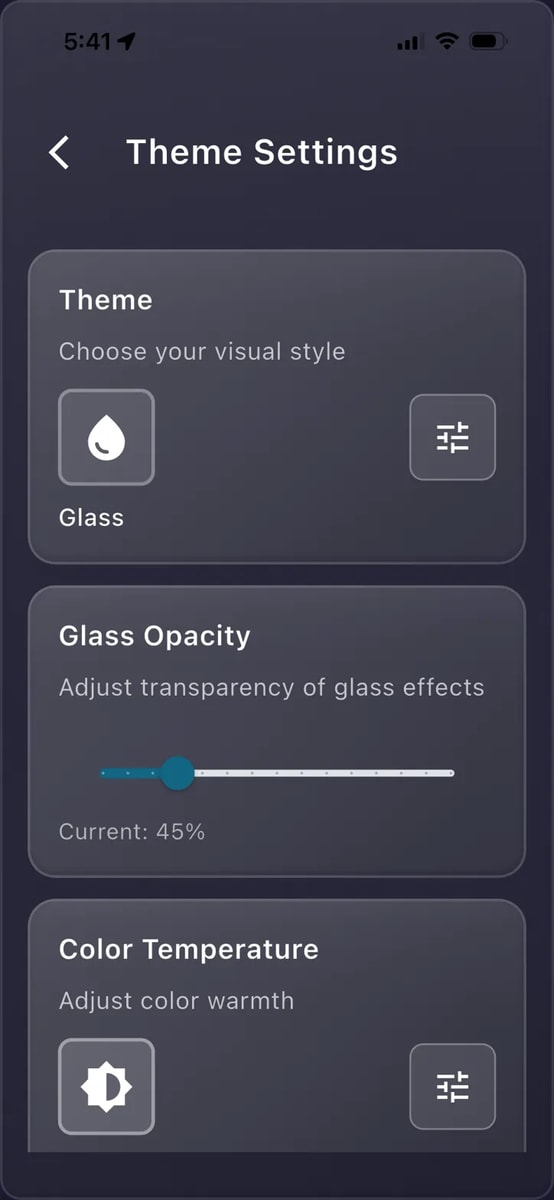
The git history is timestamped. August 11th, 9:38 PM — commit
47f48a7fe3: "new ui enhancements / glass effect slider / color temperature / accessibility enhancements." Not a planned feature sprint. I noticed some things were harder to see, added a slider to fix it, made sure the Reset Settings button stayed force-contrasted so you can always find your way back. Then I assumed Apple would ship their own version with 26.1 and mine would become redundant. It's the most obvious thing.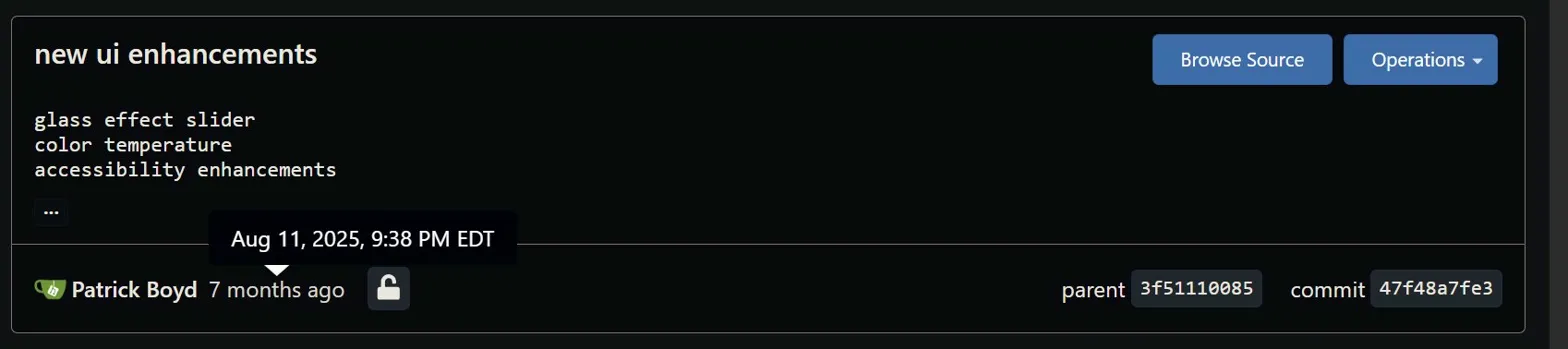
26.1 came. Toggle. 26.2. Nothing. 26.3. Nothing. 26.4. Two more toggles buried in Accessibility menus. 26.5 beta 2 just dropped. Still no slider. iOS 27 — slider rumored. Opt-out removed. Still waiting to become redundant.
Apple has since acknowledged there were "engineering challenges" preventing the slider from shipping earlier. Worth sitting with: they've been working on this internally for well over a year before anyone outside Apple saw it. They know how to build a slider — Settings has dozens of them. The challenge isn't the control. It's that Liquid Glass is so deeply baked into the OS rendering pipeline that a system-wide intensity variable has to thread consistently through thousands of components without breaking anything. They painted themselves into a corner with the architecture. The "easy win" created a structural debt that's still being paid.
Six months from public release. Months of beta before that. However long in internal pre-beta before anyone outside Apple saw it. At every stage — pitch, sign-off, dev, QA, feedback — someone could have asked the obvious question. None of the gates caught it. Apple expressed genuine shock at developer resistance. Their response was a workshop. Their next move is making it mandatory. One developer noticed the problem during a beta drop, fixed it in an evening, and is still waiting to become redundant.
That's not a premium experience. That's a premium price on a process that needed to do better. Still does.
As this post was going to press, John Giannandrea — the Apple executive responsible for the delayed Siri overhaul that Liquid Glass was shipped to distract from — is completing his final days at Apple, his stock vesting this week. The easy win outlasted the person who greenlit it.
Part of what you're paying for in the Apple premium is the confidence. Apple doesn't say sorry. Apple doesn't say wrong. Apple says the design is maturing, users will adapt, and holds a workshop to explain why your resistance is misplaced. That certainty is part of the product. Which is fine when the judgment is actually good. When it isn't — when the whole thing was a distraction from a delayed AI feature that someone pitched as a cool easy win, the kind that looks like five minutes until you're four point releases deep going "face palm, f my life" — you're still paying for the confidence. It just isn't backed by anything.
That's the judgment you're paying the premium for.
The Lock That Makes All of This Work
None of the above would matter if leaving were easy. The upgrade pressure, the App Store cut, the compliance maze, the mandatory design language — all of it is sustainable because the cost of leaving has been quietly engineered over twenty years to be higher than the cost of staying.
You probably stayed partly because of inertia. Apple Music library, purchased apps, iMessage threads, AirDrop and Handoff and Continuity features that only work Apple-to-Apple, muscle memory accumulated over years. None of those are accidents. Each is a deliberate design decision that makes leaving incrementally more expensive than staying.
The cross-platform switching tool Apple and Google announced in late 2025 — built because the EU's Digital Markets Act required it — transfers photos, contacts, and passwords. It does not transfer purchased apps. It does not transfer in-app purchases, even in apps that exist on both platforms. Game progress, unlocked content, years of accumulated purchases stay behind. iMessage history has no clean migration. Apple complied at the minimum viable fidelity.
The one thing Apple made genuinely portable is your movie and TV library. Which proves portability is a choice. They ported video content everywhere because doing so sells Apple TV+ subscriptions. The library you can take is the one Apple profits from you taking. Everything else stays behind.
Apple Passwords can export your logins — to an unencrypted CSV, manually, on a Mac. Wi-Fi passwords can't leave. Passkeys can't leave. Sign in with Apple is built on a credential Apple owns entirely. Every account you created with it requires updating to a real email address before you leave, assuming the service even supports changing your login method. Many don't. Some smaller apps have shut down entirely. Those accounts are just stranded. The privacy feature and the lock-in feature are the same feature. Apple just put a shield icon on it.
And if at some point you decide you've had enough and want out entirely — the walls are real.
You can't put competing software on your iPhone without Apple's permission. You can't run macOS on hardware Apple doesn't sell. Trying either means voiding your warranty, violating your terms of service, and potentially facing the kind of legal response Apple deployed against Beeper — a small startup they identified, responded to, and technically neutralized within days for the crime of letting Android users send blue bubble iMessages. The walls aren't a metaphor. It's a fortified castle with a moat — terms of service, warranty voidance, and a legal team that moves fast when the ecosystem is threatened. They just convinced you the castle was a feature.
What This All Adds Up To
Apple didn't build a walled garden to protect you. They built it to charge admission — and then built a brand around the idea that their judgment is worth paying for.
Sometimes it is. The hardware is genuinely good. The ecosystem genuinely works. The day-to-day experience is generally solid. I'm still here after over a decade and actively building for the platform.
But "better than the alternatives" is a low bar. And the judgment you're actually buying — the 30% cut that somehow misses the scammy subscriptions, the compliance maze that routes everyone back to Apple tooling, the design language made mandatory before it's finished, the switching costs that took twenty years to engineer — that judgment has a financial interest that doesn't always point the same direction as yours.
The brand says trust us. The receipts say check the work.
One developer. An evening. A slider. Eight months before Apple got there.
That's the judgment you're paying the premium for.
Thoughts? Find me on Mastodon at @ppb1701@ppb.social.