
A few days after I wrote about Google replacing Search with Gemini wearing Search's clothes, the numbers started coming in. DuckDuckGo's U.S. app installs spiked 30% in the week following Google I/O, sustained across six consecutive days, holding through Memorial Day weekend when DDG normally sees traffic drop. On iOS it peaked at 69.9% in a single day. The press framed it as users rejecting AI search. I'm not sure that's what actually happened.
Go look up the app those people installed. It's called DuckDuckGo, Duck.ai, & VPN. That's the name. AI is in the title. Open it up and the homepage has two buttons sitting side by side in the search bar: Search, and Ask AI. The AI-assisted answers feature — their equivalent of Google's AI Overviews — is on by default in "sometimes" mode. The actual AI-free experience lives at noai.duckduckgo.com, a subdomain you have to already know exists to find. The TechCrunch article notes that visits to that page averaged 22.7% week-over-week growth during the same period. So the people who actually went looking for the no-AI experience were a meaningful but clearly smaller slice of the 30% install spike. The rest landed on a homepage with Ask AI staring them in the face before they'd typed a single query.
And it's not just DuckDuckGo. Startpage has it tucked further down the page. Brave Search has it. They've all got it somewhere now. The idea that you can flee to a genuinely AI-free search engine in 2026 is mostly an illusion. What you can actually do is flee to a search engine where AI isn't forced on you — where it's theoretically optional, where it isn't the entire product, where there's still a search bar that just searches. That's a real and meaningful distinction. It's just not the same thing as escaping AI.
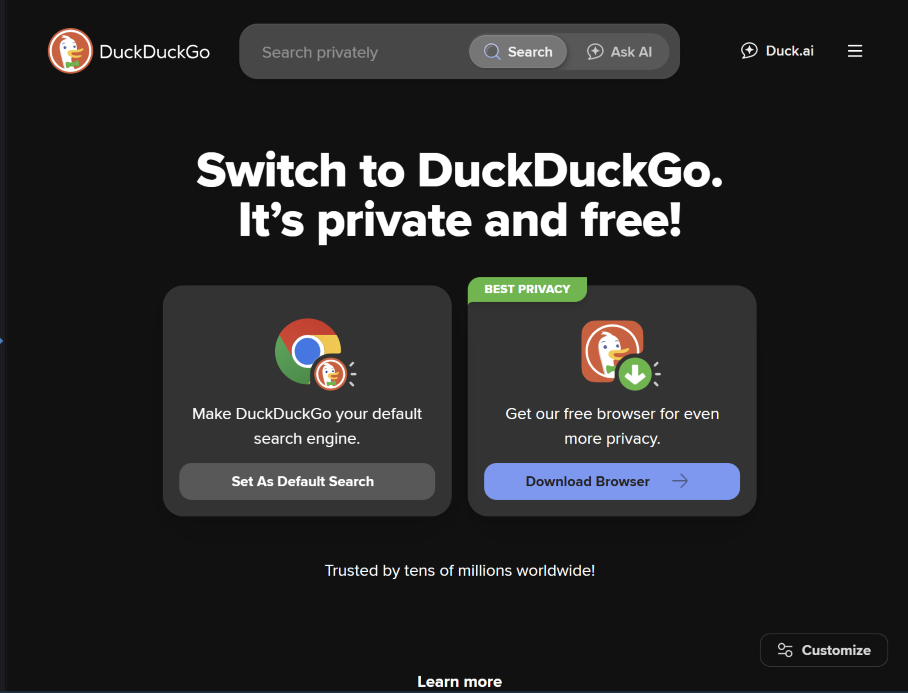
Which means what actually happened here is simpler and less dramatic than the headline suggests. People got annoyed with Google specifically — and they should be, Google eliminated the exit — and they went looking for something else. Most of them probably heard DuckDuckGo's name, did a quick search, installed the app, and called it done. That's brand fatigue with Google's specific implementation, not a principled stand against AI in search. The press wanted a cleaner narrative, so they wrote one.
DuckDuckGo's CEO called it "force-feeding AI with no way to opt out," which is accurate about Google and good positioning for DDG. But DDG is also an AI product now — it just asks slightly more politely. The difference is real. It's just not the difference being celebrated.
The actual escape, if you want it, exists. It's just not something most people are going to do. My primary search is Kagi — paid, private, no ads, AI that only shows up when you deliberately invoke it (and can be turned off entirely), results that are actually good — with a self-hosted SearXNG instance as fallback. The only reason Kagi is primary right now is that I already had the sub running when I stood up the SearXNG instance. Make no mistake, SearXNG is genuinely excellent and when the renewal comes up it's a real conversation. The instance lives at search.home, a URL that exists only on my private network. Real escape tends to look like that: unglamorous, a little technical, completely invisible to a news cycle. It doesn't make for a clean install-spike story.
None of this is a condemnation of DuckDuckGo. Their privacy fundamentals are genuinely better than Google's — no profiling, no search history, AI that doesn't train on your data, an actual opt-out path for people who go looking for it. If someone's moving from Google to DDG that's a net improvement. But "users reject AI search" as a take flattens what's actually a pretty telling moment: people noticed Google had removed their choice, they went looking for somewhere that still offered one, and they landed somewhere that also has AI, because everywhere has AI now. They didn't reject AI. They rejected being told they don't get a say.
That part I understand completely.