
Part of the ongoing Big Tech's War on Users series.
Let's go back to E3 2013 for a moment.
Microsoft had just announced the Xbox One with a suite of DRM policies that made the gaming community lose its mind. Always-online requirement. 24-hour license checks. Restrictions on used game sales. The internet was furious, and rightfully so.
Sony walked onto that stage and did almost nothing. They held up a disc. Two guys handed it to each other. The crowd went absolutely nuclear. PlayStation had just won a console generation by demonstrating the act of sharing a game. That's it. That was the whole bit. And it worked because it was a direct, explicit, mocking contrast to what Microsoft had just proposed.
Microsoft got roasted hard enough that they reversed every single policy within the week.
Sony banked enormous goodwill off that moment. Built a brand identity around it. And then, eleven years later, quietly rolled out a DRM system of their own — with no announcement, no press release, and AI-generated support responses to handle the confusion.
The disc is no longer sufficient. Sony would like to verify your license now.
What Actually Happened
The story started spreading on April 24th after content creator Modded Hardware covered it on YouTube. Digital games purchased after a specific date in March appeared to carry a 30-day expiry on their license — stay offline long enough, and you lose access to games you paid for until you reconnect and verify. Testing by the preservation community confirmed the lockout was real regardless of whether it was intentional.
Game preservationist Lance McDonald amplified the story and it blew up across gaming media. The video game preservation group DoesItPlay launched their own investigation and initially suggested the DRM might be unintentional — possibly introduced to combat refund scams, with licenses designed to convert to permanent after verification. Then one of DoesItPlay's members ran a more controlled test — removing the CMOS battery from a PS4 to force it off the clock — and confirmed this wasn't a visual bug. The lockout is real.
Content creator Spawn Wave did the same test on a PS5, booting two digital games purchased that month. Both returned the same error: "Can't use this content. Can't connect to the server to verify your license."
PlayStation Support, when users turned to it for answers, gave conflicting responses — including at least one that appeared to be AI-generated, telling users the 30-day check was intentional. A human agent, when someone actually got through to one, said the opposite: no re-authentication required, everything is fine.
Eventually, after enough noise that ignoring it was no longer an option, Sony issued a statement. Not an announcement. Not a blog post. A reactive quote to GameSpot after the story had already blown up across gaming media:
"Players can continue to access and play their purchased games as usual. A one-time online check is required to confirm the game's license, after which no further check-ins are required."
Translation: We added a license check. We didn't tell anyone. Here's the minimum explanation we could offer after getting caught.
Better than a recurring check. Still wrong. And the silence until caught tells you everything about how this was intended to land.
Wait. Why Is There A Check At All?
Let's sit with that "one-time check" explanation for a second, because Sony is hoping you don't ask the obvious question.
You have to be logged in to buy. Sony verifies your account, takes your money, ties the license to your account and console. Makes sense — transaction happened, record created.
You have to be logged in to download. File lands on your console, license tied to your account, system marks it as your primary console. Also fine. At this point Sony's servers know:
- This account bought this game
- This game lives on this console
- This is the primary console for this account
That should be it. Stored locally. Done. The license lives on the device the same way a disc does.
The only scenarios where a subsequent check makes any sense are: you're on a different console, someone's trying to access your library under a different account, or the content is a PS Plus benefit where the license is genuinely conditional on your subscription being active. That last one is the key — PS Plus games need periodic verification because the license is subscription-gated. Your subscription lapses, you lose access, that's the deal you signed up for. A check there makes sense.
A game you bought outright should have its license verified at exactly one moment: at purchase and download. That's when the transaction happens. There is no legitimate consumer reason to check again at first play.
There is one scenario where a post-download check makes some sense — full delete and redownload. If you wiped the game and are pulling it fresh from Sony's servers, that's essentially a new installation, the download is already touching their infrastructure anyway, verify it there. Fine. That's a defensible checkpoint with a natural server interaction attached to it.
But a game sitting on your drive, tied to your account, on your primary console, that you've never launched offline before? There's no technical justification. Just policy dressed as engineering.
And yet here we are.
The license token is almost certainly stored in a protected system partition — encrypted, inaccessible to the user directly. When the system clock gets disrupted — dead CMOS battery, extended offline period, whatever — the console can't validate the local token's timestamp and treats it like a new device, prompting a phone-home. Sony could have designed a more resilient local license, something durable that doesn't depend on system clock integrity to validate. They could have structured it so the purchase check at download writes something that survives a clock reset. They chose not to.
That fragility is a design decision, not a technical inevitability. A more robust local license would reduce their ability to require the phone-home moment. They built it brittle and then framed the brittleness as a consumer protection measure.
The technical architecture is a policy decision dressed up as an engineering constraint.
Then there's the language. Take a look at the actual purchase confirmation screen:
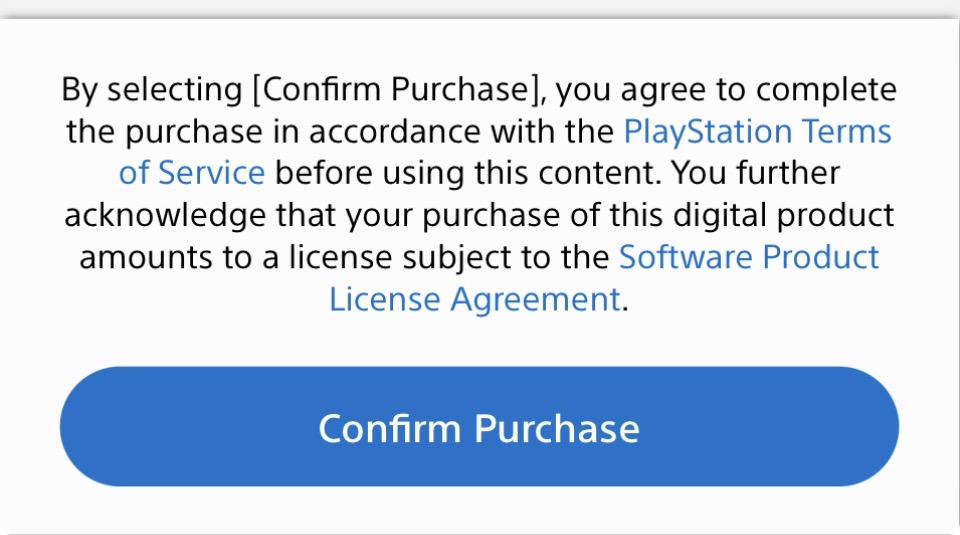
Read it carefully. The body text says "your purchase of this digital product amounts to a license subject to the Software Product License Agreement." The button says Confirm Purchase.
They told you it's a license. In the same sentence where they called it a purchase. Then put a button that says purchase on it.
That's not disclosure. That's legally defensible obfuscation. The word "license" is buried in a block of text that most people tap past in under two seconds. The cognitive flow of every person who has ever bought something on that screen:
- See game
- See price
- See big blue button
- Tap
The legal team got their license disclosure. The UX team got their frictionless purchase flow. Sony retains the legal standing to say actually you agreed it was a license, it's right there above the button you didn't read. It's the same trick as cookie consent banners — the "Accept All" button is big and blue and prominent, the actual terms require three more clicks and a law degree. Technically informed consent. Practically engineered consent.
You cannot hide behind terms of service you deliberately buried under a UI designed to prevent people from reading them.
The one-time check isn't a compromise. It's the same wrong answer with slightly less friction. And nobody announced it.
The Part Where We're Supposed to Not Notice
This wasn't a clumsy mistake. It was a calculated bet that the mechanism would be effectively invisible under normal conditions.
Think about the assumptions baked into this rollout.
Most PS5 owners are online. The console checks in silently in the background. License refreshes. You never see an error. The DRM functionally doesn't exist for the vast majority of users who are always connected.
And here's the part that makes it even more elegant from Sony's perspective: the always-on infrastructure was already normalized, at least on PlayStation. Sony has historically been among the most aggressive about forcing system updates — block PSN access, gate game launches, require updates before you can do much of anything. Games frequently force a restart even out of suspend mode to apply a patch. The architecture of always-on dependency was already baked into the PlayStation experience specifically — the license check is just one more layer of the same infrastructure most people had already stopped questioning. Sony was betting nobody would notice one more invisible thread in a web they'd spent years weaving. (Nintendo, for what it's worth, generally lets you keep playing offline and just nags you to update — but we'll get to them in a bit.)
CMOS batteries last years. By the time that battery dies on a typical console, you're probably on the next generation anyway. The scenario where the mechanism becomes visible — offline, dead battery, older digital library — is a narrow enough Venn diagram that Sony probably wrote it off.
Frequent upgraders don't accumulate the problem. If you buy a PS6 when it drops, your PS5 library doesn't disappear — Sony has actually been solid on backwards compatibility, with PS4 games running on PS5 being a consistent part of their generational story. But the active DRM question on older purchases becomes less urgent for someone already on new hardware.
What Sony didn't account for is that the exact people who would hit that Venn diagram — retro preservationists, the DoesItPlay community, people who deliberately stress-test offline scenarios — are also the most technically capable and loudest voices in the community. The ones who pull CMOS batteries on purpose to see what happens.
Sony designed DRM to be invisible to casual users and made it maximally visible to exactly the people who would document and amplify it.
And there's one more layer to why most people never see it even when they do go offline. The realistic sequence:
- Console tries to sign in automatically on boot
- Can't reach PSN
- Surfaces a system update prompt before you even get to your library
- Most people just reconnect to install the update
- License silently refreshes in the background during the process
- They never see the license error at all
The license gate is the innermost of several gates. To reach it you have to specifically bypass the update prompt, or keep the console offline as a deliberate long-term choice. Which is, again, that same narrow slice — the preservationists, the retro community, the person who took their console somewhere without internet and declined the update to just play a game.
Gates within gates. Most people never reach the innermost one. Sony knew exactly what they were building.
This Isn't New. I Have a Disc.
Before anyone argues this is purely a digital purchases problem — a story.
Xbox One. Slot-loading drive. Transformers: Rise of the Dark Spark in the drive — the 2014 crossover between the excellent Cybertron game universe and the movie continuity, for those keeping score. Took the system to a girlfriend's place one day. Internet hadn't been set up there yet. Game checks for a connection on boot. No connection, no game.
I owned the disc. The physical media. The thing you're supposed to hold up when people say "just buy physical." And it still phoned home before it would run.
That's not DRM protecting against piracy. You can't pirate a disc sitting in the drive. That's DRM as infrastructure normalization — getting you comfortable with the idea that your hardware calls home before it runs your software. Most people never hit it because most people are always online. The edge cases got dismissed as fringe complaints. And here we are in 2026 having the same conversation about PlayStation, a step further down the same road.
The Economy They Forgot To Account For
Sony's assumptions were built for a pre-tariff, pre-squeeze economy where console upgrade cycles were relatively predictable. That world doesn't exist anymore, and the gap between the world Sony planned for and the one we're actually in is significant.
The PS5 generation was already unusual before any of this. Hardware was nearly impossible to find for the first year-plus post-launch due to the chip shortage. Scalpers ate the early supply. To keep software sales alive during the shortage, Sony continued releasing major titles on PS4 as well — which accidentally validated not upgrading. Why rush for a PS5 when God of War and Spider-Man run fine on your PS4?
Then the economy started tightening. Then RAMageddon hit — AI data centers buying up memory production at scale, DRAM prices surging, NAND storage costs spiking, the entire consumer electronics supply chain taking a hit. Then fuel and energy costs. Then Sony raised PS5 prices. Then again. Then again in May 2026 for Southeast Asia. Three waves of price hikes on hardware people already own, with no next generation in sight.
And the PS6 — originally targeting a 2027 launch window, likely alongside a next Xbox — got pushed back. Possibly to 2028, possibly 2029, depending on when the RAM situation stabilizes enough to manufacture at a price point that doesn't require selling a console for $800. The next-generation revenue that was supposed to reset the financial picture isn't coming on schedule.
So Sony is trying to squeeze the existing user base at exactly the moment that the assumptions underneath that squeeze have collapsed. People aren't holding onto PS4s out of nostalgia. They're holding onto them because a PS5 got multiple price hikes and a PS6 isn't coming, and even if it were, food and gas are the competition for that upgrade budget right now.
The edge case became the mainstream. They designed the system for 2020 and deployed it into 2026.
And there's a conversation that was already happening before RAMageddon made everything worse. When the PS5 Pro launched at $699 with no disc drive, people were already running the math — add the $80 disc drive, a 2TB M.2 SSD to compensate for the base storage, and you're pushing $880-930 to get what a launch PS5 gave you in 2020 for $499. At that price point, a mid-range gaming PC was entering the conversation. Not a beast, but a platform with upgrade paths, decades of backwards compatibility, Steam sales that actually mean something, mods, no subscription to play online, and Valve's offline mode — which has worked reliably for twenty years because Valve never decided your purchases were provisional.
RAMageddon leveled that comparison somewhat — GPU and memory prices spiked hard on the PC side too. A build that was $900 pre-crisis might be $1,200-1,400 now. But if the PS6 lands at $1,000-1,200, a $1,500-1,600 mid-range PC doesn't look unreasonable against it. The gap narrows. And every Sony policy decision that erodes the PlayStation value proposition — DRM, storage shrinkflation, disc drive pairing — nudges that calculation toward PC without Sony touching the price tag at all.
They're doing the PC's marketing for it one firmware update at a time.
Who's Paying for Concord
Let's be direct: none of this is the customer's fault.
Sony's live service push was a disaster. Concord's initial development deal was reportedly just over $200 million — and according to Kotaku's sources that figure didn't cover the game's full development, the acquisition of the Concord IP, or the purchase of Firewalk Studios itself. Shut down in two weeks after launch. Players warned them during the beta. Feedback was clear and consistent. Sony launched it anyway.
That is not a user problem. That is a catastrophic executive failure. Full stop.
And it wasn't just Concord. Multiple first-party studios got redirected toward live service mandates that had no business being imposed on them. Naughty Dog spent years on a The Last of Us multiplayer project before it was cancelled. Bend Studio was pushed away from a Days Gone sequel toward live service development. Internal disruption across the board, chasing a model that largely failed.
None of that was the customer's call. The people holding PS4s and waiting patiently, the people who stayed loyal through the live service era wanting good single player games, did not make those decisions. Many actively said don't do this and got Concord anyway.
So the logic that follows is: bet big on live service, lose, raise hardware prices, quietly lock down digital libraries people already paid for, hope nobody notices.
The fans who never wanted live service are paying for it twice. Once in the games that didn't get made while studios were redirected. Again in the financial hangover that's now being passed to customers via price hikes and DRM.
To be fair — PlayStation's first-party quality isn't gone. Astro Bot, the God of War series, Returnal, the ongoing FromSoftware relationship. When they focus, they still make things worth playing. But the live service detour burned years of studio capacity and goodwill, and the customers are being asked to absorb the cleanup costs of decisions they had no voice in and didn't want.
They Did It All In One Generation
Usually this kind of erosion happens generation to generation. By the time you notice what changed you're already committed to new hardware and a new library. The gap gives it plausible cover — things evolve, hardware changes, that's just progress.
Sony did it within the same generation.
Look at the PS5 hardware arc:
Launch PS5 — two versions, disc drive or digital. Clear choice, standard feature, disc drive included in the box if you wanted it. Here's everything, day one. And worth remembering: the disc format in question is Blu-ray, which Sony invented. They unveiled the first prototypes in 2000, built the PS3 around it to win the format war against HD-DVD, and used a disc — their disc — to mock Microsoft on an E3 stage in 2013. Physical media wasn't just a feature for PlayStation. It was identity.
PS5 Slim — smaller, sleeker. Now the disc drive is a separate purchase. Sold the digital version cheaper, got you on the $80 accessory if you wanted physical. Started the unbundling. Oh and if you bought the original digital PS5 in 2020 thinking you'd add a drive later? That drive doesn't work on your console. Different model group. You need new hardware.
PS5 Pro — the premium enthusiast model. No disc drive. Higher price. The top-tier version of the console has less out of the box than the launch unit from 2020. And it costs more.
Within a single console generation, the disc drive went from standard feature to paid accessory to absent from the flagship model. No generational boundary to normalize the change. Same PS5 era, same install base, progressively redefined. And quietly, the PS5 Slim Digital Edition had its storage shrunk from 1TB to 825GB in late 2025 — without announcement in Europe or the US, just silently less than you got before at a higher price. Shrinkflation, no announcement, same generation.
The full within-generation degradation list:
- Disc drive: standard feature → paid $80 accessory → absent from flagship
- Built-in storage: 1TB → 825GB on digital Slim, quietly, no announcement
- Price: three separate waves of hardware hikes
- PS Plus: 35% price hike in 2023, more increases flagged as coming — because why squeeze the hardware end when you can squeeze the subscription end too
- Digital library: license verification added silently
- PS6: indefinitely delayed, no upgrade escape valve
That's a complete enshittification run without crossing a single generational boundary.
And here's where the disc drive story intersects with the DRM story in a way nobody's really connecting.
The detachable disc drive — the physical media escape hatch, the thing people point to when they say "just buy physical" — itself requires an internet connection to activate. Every time. Not just the first setup — every time you move it to a different console requires a fresh online registration. And since the drive pairs to the console via Sony's servers, preservation researchers have already flagged the obvious question: what happens when those servers eventually go offline?
The standard defense offered is DMCA compliance — Blu-ray licensing has historically required hardware authentication checks to protect movie studio content. That's a real requirement. But sit with it for a moment.
Sony is one of the primary inventors of Blu-ray. They unveiled the first prototypes in 2000, drove the format through development, used the PS3 to win the format war against HD-DVD, and were a founding member of the Blu-ray Disc Association that wrote the licensing and authentication requirements into the spec. Hollywood studios demanded DRM before they'd release movies on the format, and Sony helped build that authentication framework from the ground up.
So when Sony says "we need an internet check for Blu-ray compliance" — they're citing a requirement they had a direct hand in writing. That's not an external constraint imposed on them by an outside party. That's Sony pointing at Sony's own rules as justification for Sony's own DRM. They built the cage and are now citing the cage bars as an excuse.
And here's the part that really collapses the argument: the DMCA and Blu-ray authentication requirements exist specifically to protect movie studio content from piracy. That's the entire justification for the requirement being in the spec.
If you buy a PS5 disc drive and never insert a single movie — which is the primary use case for the majority of PS5 owners who bought it to play games — the movie DRM argument is completely irrelevant. Games have their own separate DRM. The Blu-ray movie licensing requirement has nothing to do with whether you can play Spider-Man off a disc.
A proportionate, defensible implementation would be: authenticate when a movie disc is inserted, because that's when the content requiring authentication is actually being accessed. Instead every drive gets checked at pairing regardless of whether a movie ever enters it. The justification doesn't match the implementation. And the people who wrote the justification are the ones deciding how broadly to apply it.
So the physical media solution requires Sony's servers to activate. The escape hatch from server dependency has its own server dependency. Built on a compliance requirement Sony authored. Applied beyond the scope that compliance requirement actually covers.
They put an online check on the way out and wrote the rulebook that made it sound necessary.
The Retailer Angle Everyone's Skipping
There's a business logic to the digital push that doesn't get talked about enough in this context.
When you buy a physical game, the platform holder splits revenue with whoever manufactured and distributed the disc — and with the retailer who put it on a shelf. GameStop, Walmart, Amazon, whoever. The retailer gets a cut. The used game market exists. A game you finish can go back into circulation and Sony sees none of that secondary transaction.
When you buy digital, Sony gets the money. Full stop. No retailer split. No used game market. No resale value on your end. The reason physical media has survived as long as it has is partly because retailers have leverage — they control shelf space, promotional placement, hardware bundle deals. They pushed back against fully digital because it would cut them out entirely.
GameStop — yes, that GameStop, the company famous for offering you $3 store credit on a game you paid $60 for — somehow ended up being the most honest voice in this whole story. During the backlash they ran an ad with a pointed message: "We believe games should work for players, not against them. If you own it, you should be able to play it, anytime, anywhere, whether you are online or offline." When GameStop is the adult in the room on ownership rights, something has gone genuinely sideways.
But that leverage erodes as the audience for physical shrinks. And platform holders have every incentive to accelerate that shrinkage. Disc-less console variants. Day-one digital promotions. Convenience framing. It all points in the same direction: toward a model where you buy a license instead of a game, the platform holder keeps everything, and used game stores become nostalgia destinations.
The DRM tightening is part of that architecture. A digital library you can't fully own, on a platform with no physical alternative, with a retailer ecosystem that's been systematically undercut — that's the destination. GameStop persists largely because physical persists. Remove physical and there's not much left to sustain it.
Nobody's Hands Are Clean
Here's the uncomfortable part. Sony isn't doing anything the rest of the industry isn't also quietly moving toward. They just did it silently, without telling anyone, while still trading on a reputation built by promising the opposite.
Nintendo does almost everything "wrong" by consumer advocacy standards. Aggressive anti-emulation legal action. DMCA-happy on YouTube. Charging full price for decades-old games. Limited release windows on classics. Online infrastructure that would have been embarrassing in 2010. DRM that, until recently, made Sony's posture look relatively user-friendly.
And yet the Switch 2 is selling. Nintendo is fine. The Nintendo faithful are faithful.
The difference is Nintendo never pretended to be something else. They never stood on a stage and got crowd cheers for not being anti-consumer. They've always been Nintendo — take it or leave it. Their customers know exactly what they're buying into. There's no betrayal in the equation because there was never a promise to betray.
Nintendo even got roasted for their own version of this recently. The Switch 2 introduced Game-Key Cards — physical cartridges that contain no game data whatsoever. You buy the box, insert the card, download the full game from the internet, and then must insert the card every single time you want to play. Internet required on first launch. Servers go down someday — useless piece of plastic. The gaming community rightly called it out. Nintendo's defense was manufacturing cost — high-capacity cards are expensive, publishers balked. There's truth in that. But Nintendo designed the system around those cartridges. They set the capacity tiers and the pricing. If the economics make full physical carts unviable, that's a consequence of design decisions Nintendo made. You don't get to create the problem and call the workaround consumer-friendly.
But here's the one thing you can say for Nintendo: they labeled the box. It says Game-Key Card right on the packaging. You know exactly what you're getting before you buy it.
Sony made a specific, explicit promise in 2013. Mockingly. On a stage. To a cheering crowd. They built a console generation of dominance on it. And then quietly implemented the same architecture they mocked — with no announcement, no label on the box, AI chatbots handling the fallout, and a statement only after being caught.
The whole industry is moving the same direction. Sony quietly, Nintendo loudly and labeled, Microsoft by dissolving into software. Different mechanisms, same destination.
Worth noting one outlier in that picture: Valve. Under California's AB 2426 Digital Goods Law, Steam updated their cart to include a plain text statement — "a purchase of a digital product grants a license for the product on Steam" — sitting right there in the purchase flow before you hit continue to payment. No contradictory button label on top of it. No license language buried in a paragraph you're supposed to tap past. Just a clear statement of what the transaction actually is. Fair disclosure on desktop at least — on mobile it may fall below the fold depending on screen size, which isn't ideal, but the intent is clear. And then Valve didn't change a single thing about how Steam actually works. Offline mode still functions the way it always has. You can still play your library without permission from anyone. The language got honest. The function stayed intact.
That's the standard. Honest language, functional ownership. Not complicated.
Sony has neither. Dishonest language and ownership that's now conditional on their servers. The "Confirm Purchase" button is still there. The license check got added anyway. Quietly.
The Trajectory Nobody Is Saying Out Loud
Follow this to its logical endpoint.
Right now the framing is: online multiplayer needs internet, live service needs internet, digital purchases need occasional verification. Reasonable-sounding, incremental, easy to dismiss each step individually.
But watch the direction:
- Physical media shrinking — disc-less variants pushed hard, retail shelf space for games contracting
- Digital dependency normalized — the pitch is convenience, the reality is license-not-ownership
- Forced updates already blocking access until completed — the always-on expectation already exists
- License verification baked in and accepted — 30 days feels reasonable until it's 7, then every boot
The single player cave — the one place gaming always protected, you bought it, yours forever, go play offline forever — quietly gets an asterisk.
Your future playthrough of whatever the PS8 equivalent of God of War is will require Sony's servers to be up. Sony to still exist in that form. Sony to honor licenses from three hardware generations back. Your internet to be working.
All for something functionally identical to a single player experience that needed none of that in 1995.
And it won't be announced as a policy. It'll just be how it is. Like how nobody announced that you don't really own your iTunes purchases. Like how Google Play Movies quietly became contingent on licensing agreements holding. It's just the water everyone swims in by the time it matters.
The music industry went digital and made physical commercially unviable. Film is on the same path. Gaming is being walked down it deliberately. The PlayStation DRM story is what that walk looks like in progress — while you can still see it happening, before it's just normal.
The Pattern
This series has a thesis: they built things we genuinely needed, got us hooked, and then figured out they could monetize the removal.
Sony didn't invent this playbook. But they applied it with a specific kind of audacity — because the 2013 version of PlayStation would have absolutely dunked on exactly what the 2026 version just tried to quietly slip past everyone.
They won a console war by promising ownership. They're quietly renegotiating the terms of that promise now, one firmware update at a time, betting that the always-online world they helped build means most people never notice.
The people who notice are the ones who still have their receipts.
And the retro folks with their SNES carts? Still playing fine. No servers required. No license check. No permission needed from anyone.
They understood the assignment before the rest of us did.
Got thoughts? Find me on Mastodon at @ppb1701@ppb.social
Part of the ongoing Big Tech's War on Users series.